Showing posts with label Travel. Show all posts

Friday, October 22, 2010

Kitchen Renovation Update--We've Come a Long Way

Sometimes, when we think about the seemingly endless number of steps remaining in the kitchen renovation, we begin to lose heart. But then we think back on how far we've come. ...And we've come a long way, baby.
Then:
The original floor plan of the back of the house as it was when we moved in

Now:
 It's taken over five years, but after gutting the original kitchen, addressing structural concerns, adding windows, restoring the house to something close to its original 1889 floor plan, and building a new master bathroom so we could remove the bathroom from its inconvenient location within the footprint of the future kitchen without losing the convenience of a second bathroom, we finally have a clean slate to proceed with our kitchen renovation.
Looking east in our new blank slate of a kitchen space

Looking West
Looking East (fireplace)
Last year, when I left off describing our kitchen saga, we'd come to a difficult decision about replacing the joists of the kitchen floor. If we wanted tile, especially tile with under floor hydronic heat (which would mean embedding water tubes in thick concrete), the century-old sagging joists riddled with ill-placed holes would have to go. They did, and with the tremendous efforts of N and my Dad they were replaced with perfectly square, structurally sound laminated beams.

Replacing the floor joists
An engineer and home builder couple once told us that over-building (that is, using materials far in excess of code) was the mark of true amateurs.  That's us! 
And we do love our house--too much not to use the best materials we can. 

Not only did the new joists reduce the floor deflection enough for us to lay tile, they also gained us almost 2 inches of headroom in the basement (which had been lost to the sagging of the old joists).

Luckily, while my dad and N were doing that, I was far away looking at castles, wandering through ruins, art galleries and cathedrals, and enjoying the beautiful city of Krakow, Poland, with my friend E.
A castle in the Pieniny mountains, the courtyard at Wawel Castle, and a self portrait walking
through an art installation at the National Gallery, Krakow
Sigh. Okay, back to work.

After joists came the subfloor: 5/8" tongue and groove plywood secured with construction adhesive and then screwed down into the joists.

Tool Tip: If you have a project that will require a lot of glue, or are engaged in long-term renovations, we recommend you spend the $100 or so it will cost to buy one of these guns: 
Foam gun and sub floor adhesive canister
If you clean the nozzle with acetone and store it upside-down when the canister is in place, you'll never regret it. We used a foaming glue specifically for subfloors that doesn't leave a raised bead of glue (like PL), especially in cool temperatures, but spreads out evenly on contact with the applied surface, assuring even coverage and good adhesion. Trust us, we have learned from experience that any tool that saves wear and tear or prevents injury to any body part is worth its price.  We wish we'd made this purchase several years earlier.

After the subfloor came framing. Then wiring--for lighting, speakers, outlets, range and hood, and future wi-fi (the lighting/wiring required a detailed plan). At the same time came plumbing for two sinks and a separate waterline for unsoftened water. Plumbing costs, if you don't already know, mount quickly, and are a bit of a wild card. Budget for more than you expect. Oh, and then a new gas line for the range. And after all this came insulation--sprayed-in foam to a depth of 3 1/2". Did you know that every insulation company has a proprietary colour of foam?  We've had icy cool blue, but this insulation was pink.
Pink foam insulation
Pretty, huh? Considering that most of our walls were previously uninsulated and where we did have insulation, it looked like this:

Insulation circa 1880--Yes, paper bags of straw!
--any insulation would be wonderful. The R-value of the sprayed insulation should be about 5 per inch, which might just make up for the new large window and longer replacement windows we added. And, since I'm on the topic of insulation, I'll mention that we also applied sound insulation, in the form of mass loaded vinyl, to the toilet stack which still runs through the wall in the kitchen.  

The toilet stack insulated with a sheet of mass loaded vinyl


It seems to have worked.   Then, after months and months of this tedious infrastructural work, and many cheques to many trades, we hid it all behind big blank expanses of drywall. And, like a bad dream, it was all forgotten...except of course for the photographs. You know, I can hardly stand to write about it..it's like dredging up a murky past.

To be continued...

Wednesday, May 20, 2009

Interstice

Well of course there are REASONS for our long and unannounced trajectory away from the blogosphere.

Somewhere over the Atlantic

We’ve been away, for one, making six virtually unplanned cross-Atlantic flights over two months at the beck of both business and friendship--a little April in Paris, a few strolls along the lake in posh Geneva, a hike along the Polish/Slovakian border in the Pieniny mountains, an evening sipping Prosecco in one of Europe’s most beautiful squares in Krakow, the pleasure of looking at art and architecture, old and new, in and out of the EU, and many unforgettable meals, but also a stomach wrenching plummet into grief at the unexpected loss of a young and accomplished good friend—one of the best people anyone could ever hope to know. Things either so light as to dissipate instantly when I tried to catch them in words, or so leaden that they crushed my thoughts before I could write them. Nothing apropos at all.

One of those world-between-world intersticial airport spaces

I attribute our absence to existential imbalance. Plus inertia.

The YYZ tarmac--home

Now we are back on more solid ground (but not quite so solid floors). So, if you’re still with us, stay tuned for some harrowing renovation tales, lightened with the odd travel memory.

Wednesday, October 1, 2008

Art Acquisition or A Thing of Beauty is a Joy Forever

As our savings dwindle and our RRSPs shrink before our eyes, we are glad that we haven’t always scrimped to save, and that some of our money is already spent on things we still have and will continue to enjoy forever. Specifically, I’m thinking about the beautiful ceramic platter we bought on vacation this summer. For five of the last six summers, we’ve found ourselves renting a tiny place right on the ocean in Nova Scotia. Because we always plan a return, we’ve never felt the need to lug home any souvenirs from our trip. But this year we decided that nothing stays the same forever and we needed to mark the event somehow—to bring something home that would remind us of our wonderful summers. Souvenir shopping can be fraught with problems. We want something that won’t wind up in a junk drawer, something unique, something that fits or is allowed across the border, or on the plane, or in the already overpacked car, something that will always return us to a moment in time, a place, an experience, the feeling of a vacation. In the globalized world, it can be hard to find something you can’t find anywhere else. The last time we were in France (on the highway and in need of a WC), we checked out an IKEA store to see if there were any major differences between ours and theirs, and, no surprise, there was virtually none. Okay, I know IKEA is an extreme example of uniformity, but it illustrates the problem of the ubiquity of mass produced goods. Our solution is to look for local artists or artisanal producers, antique shops, or something from the natural world.

So, one day on our seaside vacation, we set out on an ambling drive with the vague objective of acquiring something to take home. We wound up in Chester, a patrician sailing town full of lovely old houses, a gentle coastal landscape, calm marina, and many tourists. We passed by many little shops crammed with ill curated selections of tourist luring products. Although there may have been some treasures within, N and I are not hard core shoppers, and didn’t feel up for a hunt.

Jim Smith's studio and store front (images from jimsmithstudio.ca)

We were on our way out of town when we drove by a gorgeous storefront window so beautiful, that even at driving speed, we knew it was something special. We turned around, parked, walked in and discovered the studio and tiny storefront of acclaimed ceramicist, Jim Smith. We weren’t surprised that a place so striking and singular was the product of a fine artist. Inside, the ceramicist’s partner, Shannon, was painting a white clay slip over the surface of some heavy red clay plates. She explained the artist’s process: Jim forms his plates, vases, platters and bowls from the native red clay of Nova Scotia. Then, a fine white clay is applied over top. When the white slip has dried to the appropriate texture, Jim draws his evocative and thoughtful patterns into the slip revealing the red clay beneath. Coloured glaze is applied and the object is fired again. The look of the objects is both substantial and delicate. The patterns are not merely painted on, but carved into each piece. They all evoke the rich world traditions of ceramics and manage to appear simultaneously fresh and ancient. Jim himself was listening to our conversation and came out from his studio to meet us. He is passionate about his work and excited about his new pieces. It’s nice to meet a non self-effacing artist so evidently proud of his work. Jim is a sophisticated artist with a very disciplined practice. His work is unique, and I think that is especially unusual in the realm of functional ceramics. We fell in love with his style and his philosophy and purchased a beautiful platter to take with us and ordered two dinner plates (his plates are the only non-existing pieces he accepts orders for). The plates should be fired any day now and should arrive here sometime this month. We plan to visit Jim Smith’s studio every time we return to the south shore and amass a collection of his work bit by bit. I hope you'll visit his website and take a look at his beautiful work.

Large oval platter with peas by Jim Smith, 2008

Souvenirs of trips past:

Our most daring import was from a trip to France. We brought home a little cooler full of unpasturized, semi-dry, washed-rind goat milk cheese in various stages of ripeness (and mold growth) called Picodon de Dieulefit. When we showed up unannounced on his doorstep, the cheese producer had taken us into the ‘cave’--really more of a warehouse--where the little round cheeses age, and fed us samples of cheese from its smooth-textured fresh beginnings to its incredibly piquant full maturity. We couldn’t help ourselves; we had to take some home. The cooler, suspicious looking in its swathes of yellow Lufthansa packing tape, made it home without drawing the slightest interest from customs officials. What they pulled us out of line to question us about was a bag of tulip bulbs clearly labeled as approved for importation to Canada that we’d picked up at the Schiphol airport. Go figure.

The Picodon cheese label. The cheese, unfortunately, is long gone

Our most used vacation souvenir is the beautiful yellow and green coffee service we bought on the same trip in Poteries des Grottes Dieulefit. We use the little yellow cups every morning for shots of espresso (yes, we are unabashed espresso, latte, and cappucino drinkers).

Some pieces from our coffee service from Poteries des Grottes Dieulefit

I also love the tiny fig leaf pressed into the pages of a travel journal (everytime I find it there, it brings a smile to my face), and...

fig leaf

a brass cicada pin from a little shop in Provence where the cigale is a ubiquitous symbol of good luck, and...

The brass cigale (cicada) pin

books. I’m always seduced by gallery catalogues or histories of historic buildings or gardens.

I’d love to know what other people bring home from vacation. Do you shop/collect/gather alone or with someone else? What is your favourite vacation souvenir?

Friday, May 2, 2008

Las Vegas 2008 (a mini treatise)

The Palazzo Tower viewed from the pool

Las Vegas is an easy city to mock from a distance and it is indeed a strange place-- constantly destroying itself and rising again out of the ashes, more spectacular in every new incarnation. I am not a gambler, nor in the market for the kind of legal and somehow sanitized smut that Vegas sells. Las Vegas is a temple to Mammon. Though many people balk at paying their taxes for the greater good, Vegas seduces thousands into willingly pouring their incomes into slot machines and watching amazed as the golden palaces they have funded rise up in the desert.*

The construction never stops (the view over my shoulder at the Palazzo pool)

I have been accompanying N to a huge tradeshow for over a decade and I still don’t know entirely what to think. Vegas never would’ve been high on our list of destinations, but I confess we’ve enjoyed most of our visits. Tourist towns are often single faceted, but the tourists in Las Vegas are far from homogeneous and the city is more complicated than you’d think. Flying in over the impossibly vast desert, though, it is difficult to escape the sense that this glittering oasis surrounded by the harshest of landscapes, entirely dependent on imported food and water, is the very model of unsustainable consumption and perfectly poised for its very own Armageddon.

A slightly colour-enhanced view of the vast desert en route to Vegas

In the meantime, though, the world continues to flood in to Vegas--often not as pure tourists, but as business people attending the myriad tradeshows, not to mention new residents. Las Vegas is one of the fastest growing cities in the US

When we first went to Las Vegas a dozen years ago it was difficult to find a decent cappuccino on the Strip and now there are espresso shops everywhere, bakeries as fine as Thomas Keller’s Bouchon bakery, and many Michelin starred restaurants.

A perfect macaron--the croissant and beignets didn't last long enough to be recorded

Just 300 miles away, LA food lovers were alarmed this year that a restaurant in Las Vegas, Joël Robuchon (at the MGM Grand), and none in Los Angeles had been awarded Michelin’s highest three star rating. Some hotels (Wynn) have insisted that the big-name chefs actually be present in the kitchens of the restaurants sporting their names.

Images from Bouchon: encaustic tile floor, pain perdu, zinc bar, white aproned waiter

N and I have enjoyed many of our meals in Vegas. Our favorite have been in the beautiful room of Thomas Keller’s Bouchon in the Venezia tower at the Venetian—a quiet oasis far from the casino floor filled (by day) with sunlight from the courtyard and pool gardens beyond, a long gleaming zinc bar, gorgeous patterned encaustic tile floor, white-aproned waiters and sparkling glass and silverware. We’ve eaten breakfast and dinner there many times over the past few years. On one memorable evening, owls swooped over the courtyard as we dined on the terrace under the clear desert sky. The food at Bouchon is classic bistro fare—duck confit and steak frites, rustic pate with cornichons, artisanal cheese, and tarte citron. It’s the food we love. Accompany dinner with a bottle of Schramsberg sparkling Blanc de Noir and we are almost as happy as we are in France, but we have no illusions; we’re in Vegas and we know it. At breakfast there is ‘pain perdu’-style French toast, eggs gratin, and lovely, buttery, flaky, tender croissants and brioche in a basket.

Views from Daniel Boulud Brasserie at Wynn (left, right) assorted pickles with my pate (centre)

This year we also dined at the Daniel Boulud Brasserie overlooking the spectacular golden waterfall and temperate forest at Wynn (yes, perverse, but very seductive). The food was good, also French bistro fare, but the mood is much more lush and dark and much more about spectacle than at the classic crisp and sparkling Bouchon. We also had a passable dinner at Woo—a pan-Asian concept restaurant in the Palazzo (our luxurious hotel next to the Venetian--every room a suite), which offered far less of a culinary adventure than it purported to. We did enjoy a bottle of unfiltered sake there, though—mild and slightly thick. Though noisier and less romantic, I'd recommend Noodles at the Bellagio over Woo any day.

The Guggenheim-Hermitage and Vegas--a doomed seven year menage a trois

While great food might find a comfortable home in Las Vegas, some partnerships are too unholy to survive. For the last few years I’ve enjoyed visiting the Guggenheim/Hermitage Museum in the Venetian hotel, where I’ve seen some excellent exhibitions (two Van Dyke portraits being a revelation to me when seen for the first time in person). Unfortunately for me, the museum will close forever this May. I loved the small museum and its hybrid shows drawn from the collections of two of the world’s finest museums, but I guess I should’ve surmised, based on the fact that I was usually alone with the art and several security guards, that it would never last. For me, it was one of the most redeeming and incongruous features of Las Vegas.

The Palazzo lobby; the golden falls at Wynn; a view from the outdoor bar at Wynn

Another is the architecture. Yes, much of Vegas is terrible architectural pastiche, but nowhere in the world can you experience the soaring spaces exquisite surfaces and amazing craftsmanship (by imported plasterers, stonemasons, tile setters and other specialized trades) in such abundance—not to mention the constant spectacle of new construction, which is exciting in itself.
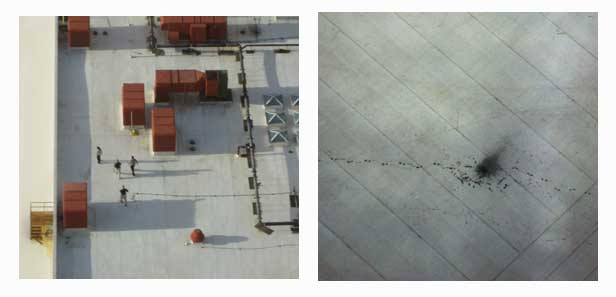
Rooftop intrigue out my window: the A-team deploys (right); and what happened here?

If you can abandon any quest for authenticity (usually a doomed pursuit anyway) and look instead for an atmosphere, a fleeting mood, I'm sure you can find a spot to love in Las Vegas. Like everything else in Las Vegas, though, the architecture is divorced from context—everything is trying to be someplace or something else—the ultimate simulacrum. And yet, Vegas clearly is itself; there is simply no other place like it. I think that’s the thing that has people so alarmed—the idea that Vegas could assert authority as its own particular place and not merely a pale imitator masquerading as something else. Vegas is beginning to mark its territory and declare its identity as clearly as the cities it takes as inspiration. Las Vegas is a self-referential alternate universe, constantly engaged in its own reinvention.

I haven't even started on the wonders of the surrounding desert, and I won't, at least not this time...

*We’re perfectly happy to pour our dollars into food, drink, car rentals, and accommodation, which probably makes us equal contributors--just worshipping at a different altar.

Tuesday, February 19, 2008

Tile Update and French Muses

Before ordering our tile, which took us just under two years to choose, we carefully calculated the necessary amount of every type of field and trim tile and added 6% more to accommodate broken tiles and waste. Unfortunately, things change, well, some things change, and some things are just miscalculations. Anyway, the changes were not in our favour. Harry discovered our shortfall of tile and I donned my role as contractor (and general gofer) and spent today driving to and from Toronto, to both of our tile suppliers to buy two small boxes of additional tile. Very luckily for us, the necessary tile was in stock. I’ll have to remember, in future, that special order tiles require far more accurate calculations. While hanging about in two different drafty warehouses waiting for people to pick my tile orders, I was struck by the contrast between the showrooms’ calculated displays and the homeliness of things when stripped of their glamorous context. Why does the stuff in the clearance bin never look nearly so appealing as it would in an orchestrated display? Context really is everything.

Tile progress showing baseboard and ogee

When I got home from my little trip, I was thrilled to see the progress Harry had made. In one corner he’s completed mortaring the wall tile and it’s becoming easier to extrapolate how the room will look. This morning we tacked up our window trim, which has been lying in stacks in the basement waiting to be refinished, so Harry could tile up to and around it. The progress right now is exciting. I’m glad that we chose to abandon our black inset tile for glass and stick to a more monochromatic palette.


scenes from La Maison de Rhodes, Troyes, France

Ever since a trip to France for our tenth anniversary, our plan had been to adopt a lighter scheme upstairs. When the pale porcelain wood tile we were going to get from Italy fell through, we kind of lost our way. Subsequent trips to Palm Springs, where we were seduced by the graphic Hollywood Regency style of the Viceroy hotel, and San Francisco, where we toured some of the famous painted lady Victorians, had us stylistically confused for a while, but recently we rediscovered our original muse. Our inspiration came from one hotel in particular called La Maison de Rhodes in Troyes, Champagne, France. Of course our Victorian house will never be a half-timbered 17th century, slate roofed manor house on a cobblestone street, but we hope we can recreate something of the mood of the place. When I remember it, I think of the textures: bleached ancient wood worn smooth by feet or hands, rough brick, smooth stone and tile. Everywhere, one surface butted up against another, but the overall effect was far from jarring or discordant. Instead the feeling was familiar and somehow stimulating. The surfaces all invited further examination, and touch. My eyes didn’t just gloss over the place, they looked everywhere and at everything and were constantly rewarded. I want to do that here. I think the unifying factor was colour. Although the palette didn’t seem artificially restricted, the surfaces were all drawn from a similar palette of I suppose natural, or elemental colours like clay and limestone and wood. That’s one of the reasons I’m glad we’ve avoided high contrast in the bathroom. Constrast reads too easily. It presents a conclusion before giving a chance for exploration. I didn’t intend to state a thesis here, but maybe I’ll think about this a little more and try to see if I can work out my own theory about what I like and why.

Friday, January 25, 2008

Windsor and Bray


After three nights at a suburban business hotel about 10 minutes outside of Reading, we escaped to spend the weekend in Windsor. Our hotel, the Harte and Garter, which is a combination of two 14th century hotels, had just undergone a renovation and wore a new palette of pale blue-greys, rich browns, and silver printed wallpaper in combination with its historic dark wood, sparkling bevelled glass, and plaster mouldings. The effect was one of relaxed, unpretentious glamour.

Our second floor room had two sets of french doors opening onto a narrow wrought iron balcony overlooking Windsor castle and the bustling street scene below, which was great except that one set of doors was in the bathroom and required us to sacrifice either modesty or the view. Despite that and the single glazing, we loved our room. The British should really try the benefits of the second pane, not just for warmth, but noise reduction. How could we have guessed that all those cardigan wearing, umbrella toting, tea drinking, sensibly shod Brits would turn into such loudmouthed hooligans after a Saturday night down the pub?

One of the best things about tacking a couple of days vacation to the end of a business trip is finding ourselves in places we'd never have imagined being. A cross Atlantic flight to spend a weekend in Windsor England in the middle of January would probably not have occurred to us, but I loved everything about it. For one thing, we didn't realize that Berkshire county was a mecca of fine dining and a site of culinary pilgrimage. The tiny village of Bray just a few km outside of Windsor has two three star Michelin restaurants and a gastro pub noted by Michelin and claimed as one of the best in Britain. Heston Blumenthal, the mad scientist, alchemist chef who runs the legendary Fat Duck restaurant where he serves molecularized, atomized, and reconfigured food a la Jetsons meets haute cuisine, also owns the more prosaic Hinds Head Hotel, an 18th century pub committed to traditional British food cooked with local ingredients and served simply. We were torn between the experimental and the traditional, but tradition won out (not least because the Fat Duck tasting menu with wine comes in at a little over 200 British pounds per person and we thought that a meal at that price requires at least a few months of anticipation and possibly temporary insanity).

Our evening at the Hinds Head Hotel was great. Dropped off by taxi in the dark and the rain, we stepped hastily through the front door and right into what seemed the archetype of a British pub--low, timber-beamed ceilings, worn wooden floor, gleaming warm wood panelling, substantial fireplaces, and a bunch of locals at the bar. We were ushered by an extremely young bartender, who looked as though he were playing hookey from Eton college, to our simple wooden table in the adjoining dining room where the pale walls reflected the glow of candelight and mullioned windows looked out on the village. The restaurant was full of happy couples and groups pleased with their good sense at eschewing the avante garde for historic comfort food and saving enough for cab fare back to London.

And so, to our meal. To begin, I had the rabbit and bacon terrine, rustic and coarse textured, served with tiny cornichons and toasted bread. I could live on this. N had the goat cheese tart hidden under a chiffonade of something green (it was gone before I could move my fork across the table. Our wine was a bottle of Chateauneuf du Pape. As a main course N had the Rump steak (yes steak, not roast) cooked perfectly medium rare and served with a decadent bone marrow sauce. I had the Lancashire hot pot made with lamb. Originally, the hot pot would've included oysters, once a cheap source of protein for the working classes, our waiter explained, and as homage to the original dish a single oyster was baked in. Just writing about that that succulent baked oyster awakens cravings. As tradition dictates, the accompaniment to my hot pot was stewed red cabbage, which looked beautiful with an added side order of broccoli with anchovies and almonds.

For dessert (or should I say pudding?) we were heartbroken to learn that the quaking pudding (click here for desciption and recipe) that chef Blumethal had patiently adapted from a 1660 cookbook was sold out for the evening! Alas. But we calmed ourselves down, N with a glass of Oban and me with a Calvados XO. After much debate with my overfull stomach I gave up on the local cheese platter and chose instead the Eccles Cake, a decadent little confection of currants and raisins stuffed into puff pastry. Unfortunately, I learned too late that it should really have been accompanied by a slice of the very Lancashire cheese I had passed up. N had the treacle sponge, which was the sweet epitome of a sticky steamed pudding. We left feeling content and full but not quite missing the irony that we'd paid the equivalent of a dinner at Susur in Toronto for the chance to eat what centuries before had been the everyday food of the working classes served in a charming, but entirely homely setting.

Other meals of note included dinner at Gilbey's in Eton, a local favourite, and fully booked on a Saturday night. We stopped by earlier in the day and were lucky to get a 6:00 dinner reservation at a coveted table in the front window with a promise to vacate in time for the 8:15 reservation. As a bonus, our early dinner meant we could order from the early evening prix fixe dinner menu available just until 7:00. We also had several cream teas, one at the much photographed Crooked House of Windsor and one at a little antique shop with a couple of tables tucked inside. Unfortunately, we don't think we have experienced the ultimate tea time and will just have to keep trying until we do.

Wednesday, January 23, 2008

London Galleries


While N attended business meetings, I braved the National Rail system, the London underground, and pouring rain on successive days to make my way to the National Gallery, the Portrait Gallery, and the Tate Britain. I love the luxury of going to public galleries alone and lingering wherever I want. The Portrait Gallery in particular has been a destination I’ve dreamed about. (One day, if I settle down enough to be articulate, I may write a letter explaining why the site of the Canadian Portrait Gallery should be Ottawa, our nation's capital, and not any one of the competing regional sites). No photography was allowed, even without flash, but the gallery has an amazing feature: if any painting catches your eye, you can make note of its catalogue number or subject or artist and have a copy of it printed from the digital catalogue in the gift shop when you leave. I was struck once again by the marked difference between the idea of a painting I have from print images and experience of standing in front of the real thing. There is a kind of vibration that happens between colours—strange tensions produced by pigments of similar intensity but subtly different hues—that print reproductions never seem to catch. Some paintings just pulse. The Hockney on Turner exhibition at the Tate was my favourite of the specially curated big shows. Turner has never meant much to me, but I was completely won over.

Just a word about the gallery cafes--the British are seriously addicted to tea and cakes. At the National Gallery cafeteria, just to get to the main course food, you must bypass a marble topped multi-tiered island crowded with cake stands and shiny silver lifters and laden with gorgeous iced cakes and slices of pound and nut cakes and fruit loaves and tarts. It was all outrageously decadent. Suddenly the food obsessions of all those British children in the Enid Blyton books made perfect sense. I thoroughly enjoyed the domestic hedonism. I may have to take up the habit of afternoon tea.

Tuesday, January 22, 2008

Going to London


Flying in to Heathrow earlier this month, just after dark, our plane was forced into a holding pattern by a backup at the airport. As we circled London and its neighbouring towns I kept noticing these luminous unnatural green patches on the landscape and couldn’t make sense of what I was seeing: water treatment lagoons, or maybe giant solar panels that somehow fluoresced after dark like radioactive watch hands? The colour was as oddly green as that glass of absinthe in the Degas painting. And then it dawned on me—football fields, artificially illuminated, hundreds of them. We were truly not in Kansas, um Canada, any more.